

Brain-Computer Interfaces (BCIs) are changing the way researchers think about communication between people and digital systems. Instead of depending entirely on keyboards, touchscreens, microphones, or physical controllers, a BCI can interpret selected patterns of brain activity and convert them into commands for an external device. This creates a communication pathway between neural activity and technology, potentially allowing users to interact with computers, robotic systems, communication tools, and assistive equipment in entirely new ways. Modern BCI research combines neuroscience, signal processing, artificial intelligence, electronics, and human-computer interaction.
The concept becomes particularly important when traditional physical interaction is difficult or impossible. People with severe movement or communication limitations may benefit from systems capable of translating intentional neural activity into usable commands. At the same time, researchers are investigating how BCIs could make everyday technology more adaptive and responsive. whitemagz examines this emerging shift as an important step toward interfaces that respond not only to physical actions but also to patterns generated within the brain.
How Neural Signals Become Digital Commands
A BCI does not simply “read thoughts” in the science-fiction sense. Instead, it generally detects measurable patterns of brain activity associated with particular intentions, responses, or mental states. Sensors collect neural information, processing systems remove unwanted noise, algorithms identify useful features, and decoding models translate those patterns into commands.
A simplified BCI workflow includes:
- Signal acquisition: Sensors collect measurable brain activity.
- Signal processing: Unwanted noise and interference are reduced.
- Feature extraction: Relevant neural patterns are identified.
- Signal decoding: Algorithms associate patterns with intended commands.
- Device output: A computer, prosthesis, robot, or other system performs an action.
- Feedback: The user receives visual, auditory, or physical feedback.
This process can become a closed loop when the user’s response to the device influences subsequent system behavior. Such feedback is increasingly important because effective interaction is not simply about sending commands; it is about creating a continuous relationship between human intention, machine response, and adjustment.
Different Approaches to BCI Technology
BCIs can differ considerably depending on how neural information is collected. Non-invasive systems generally measure activity from outside the skull, while invasive systems use electrodes positioned closer to or within brain tissue. There are also approaches that occupy a middle ground between these categories.
Each approach involves trade-offs involving signal quality, safety, portability, complexity, cost, and practical usability.
| BCI Approach | Signal Access | Major Advantage | Key Challenge |
|---|---|---|---|
| Non-invasive | Sensors outside the skull | Greater accessibility | Lower signal precision |
| Minimally invasive | Sensors closer to neural tissue | Improved signal quality | Greater technical complexity |
| Invasive | Electrodes placed within the brain | High-resolution neural signals | Surgical and long-term considerations |
| Hybrid systems | Multiple signal sources | Flexible interaction | More complex integration |
Non-invasive systems are particularly attractive for research and applications where avoiding surgery is important. Invasive systems, meanwhile, can provide higher-fidelity information and have demonstrated potential in advanced assistive applications. Current research continues to explore how these approaches can become safer, more reliable, and easier to use.
Why BCIs Could Change Human-Device Interaction
Traditional interfaces require people to translate intentions into physical actions. A person wanting to open an application moves a mouse, taps a screen, or speaks a command. A BCI introduces another possible pathway: neural activity itself can become an input source.
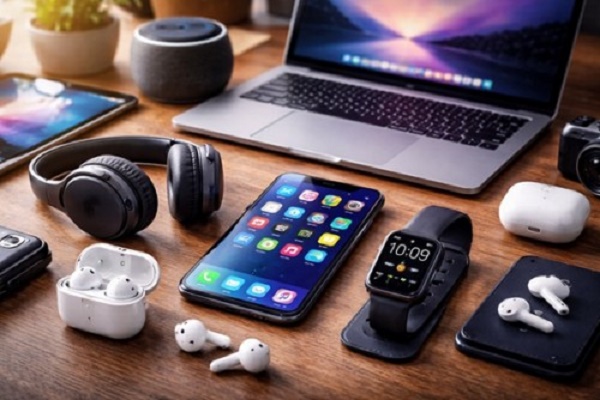
This does not necessarily mean conventional interfaces will disappear. Instead, future devices may combine several interaction methods. A laptop, vehicle, robotic system, or wearable could potentially use touch, voice, gestures, eye movements, and neural signals depending on the user’s circumstances.
/rising-kashmir/media/media_files/2026/07/17/image-view-1-2026-07-17-00-15-02.png)
This multimodal approach could be especially useful when one interaction channel becomes inconvenient. For example, a worker wearing protective equipment might have limited access to physical controls, while a person operating a complex system may benefit from hands-free commands. whitemagz highlights this broader concept of interaction as technology moves toward interfaces that can accommodate different human abilities and environments.
Healthcare Is a Major BCI Opportunity
Healthcare remains one of the most significant areas for BCI development. Researchers are exploring systems that can assist people with movement impairments, communication difficulties, and neurological conditions. BCIs may allow certain users to control assistive devices without relying exclusively on conventional muscle movement.
Potential applications include:
- Robotic prosthetic control
- Communication assistance
- Neurorehabilitation
- Wheelchair interaction
- Computer cursor control
- Robotic arm operation
- Experimental sensory restoration
- Monitoring selected neurological states
The value of these systems is not simply technological. For an individual who cannot reliably use conventional input devices, a neural interface could provide an alternative communication pathway. Research has already demonstrated BCIs capable of supporting external device control, communication, and rehabilitation-related applications.
However, clinical use requires much more than a successful laboratory demonstration. Reliability, safety, training requirements, affordability, long-term performance, and individual differences all have to be considered before widespread adoption becomes realistic.
AI Is Making Neural Interfaces More Adaptive
Artificial intelligence is becoming an important component of modern BCI systems because neural signals can be noisy, variable, and highly individual. A decoding model needs to distinguish useful patterns from irrelevant activity while adapting to changes in the user’s signal.
Machine learning can help identify relationships between neural patterns and intended actions. Over time, adaptive algorithms may also learn from user behavior, allowing systems to personalize their responses.
For example, imagine a neural interface controlling a robotic cursor. A beginner may initially generate inconsistent signals, producing slower or less accurate movements. An adaptive system could learn the user’s patterns and improve its interpretation as more data becomes available. This creates the possibility of an interface that becomes increasingly personalized rather than relying on exactly the same decoding model for every user.
whitemagz views this combination of neuroscience and AI as one of the most important factors shaping the next generation of human-device interaction. The future may involve systems that continuously learn how an individual interacts rather than expecting the individual to adapt completely to the machine.
BCIs Could Transform Accessibility
Accessibility is another area where BCIs could produce meaningful change. Conventional digital systems often assume users can operate a keyboard, mouse, touchscreen, controller, or voice assistant. These assumptions do not work equally well for everyone.
Neural interfaces could provide alternative input mechanisms for people whose physical abilities make traditional controls difficult. The goal is not necessarily to replace existing accessibility tools but to add another option to the technology ecosystem.
A future accessibility environment might combine:
- Neural commands
- Eye tracking
- Speech recognition
- Gesture detection
- Adaptive keyboards
- Assistive robotics
- Personalized software controls
Such combinations could give users greater flexibility. A BCI could handle one task while another input method manages a different function. This multimodal design could ultimately be more practical than expecting one interface technology to solve every accessibility challenge.
Gaming and Virtual Environments
Gaming offers another fascinating environment for BCI experimentation. Conventional gaming depends on controllers, keyboards, mice, motion tracking, and touch interfaces. Neural interfaces could introduce additional signals that influence gameplay or virtual environments.
Rather than simply pressing a button, a player might eventually use trained neural patterns to select actions, navigate menus, or interact with adaptive game systems. BCIs could also support systems that monitor cognitive workload or engagement and adjust aspects of an experience.
Virtual reality could make this concept even more interesting. When combined with immersive displays, spatial audio, motion tracking, and haptic feedback, neural input could become another layer in an interactive environment.
The most practical early applications may not involve completely hands-free gaming. Instead, neural signals could complement existing controls, providing secondary commands or adaptive information that enhances conventional interaction.
Smart Devices Could Become More Context-Aware
The future of BCIs may extend beyond specialized medical equipment. Researchers are also interested in passive and adaptive forms of brain sensing, where systems respond to a person’s cognitive state rather than waiting for an explicit command.
Consider a wearable device that detects signs of mental fatigue and adjusts notifications, interface complexity, or workload. A vehicle could potentially use neural information as one additional signal when assessing driver alertness. A productivity system might adapt the presentation of information based on measured cognitive conditions.
These concepts remain areas of research rather than universal consumer capabilities. Nevertheless, they demonstrate an important evolution in interface design: technology could become more responsive to human conditions instead of simply waiting for conventional commands.
Privacy and Ethical Questions Cannot Be Ignored
The ability to process brain-derived information introduces serious questions about privacy. Data generated from neural activity could be considerably more sensitive than ordinary interaction data. Even when a system is designed only to recognize specific commands, users may reasonably want to understand what information is collected, how it is processed, and who can access it.
Important considerations include:
- Neural data privacy
- Informed consent
- Cybersecurity
- User autonomy
- Data ownership
- Algorithmic transparency
- Long-term safety
- Equal access
Researchers and policymakers will need to address these concerns alongside technical development. Recent reviews emphasize privacy, mental autonomy, informed consent, safety, regulation, and accessibility as significant considerations in BCI development.
A successful neural interface should therefore be judged not only by how accurately it controls a machine but also by whether users can trust the technology.
The Technical Challenges Ahead
Despite rapid progress, BCIs remain difficult to develop and deploy. Neural signals are complex and can vary between individuals and even within the same person over time. Sensors can experience interference, and systems may require calibration or training before they perform reliably.
Other challenges include:
- Limited signal stability
- Hardware size and power requirements
- Computational demands
- User training
- Calibration time
- Cost of advanced equipment
- Clinical validation
- Long-term reliability
- Security against unauthorized access
Invasive approaches introduce additional medical considerations, while non-invasive systems may face limitations in signal precision. The field therefore involves a continuing balance between performance and practicality.
The next breakthrough may not come from improving only one component. Better sensors, algorithms, materials, wireless systems, and interface design will likely need to develop together.
What the Future of Human-Device Interaction May Look Like
The long-term future of BCIs is unlikely to be a world where everyone communicates with machines solely through thought. A more realistic possibility is an ecosystem of multimodal devices that combine neural information with existing technologies.
A future computer could understand a mixture of physical movement, speech, gaze, gestures, environmental context, and selected neural signals. Instead of replacing familiar interfaces, BCI technology could become another layer within them.
whitemagz sees this direction as particularly significant because it changes the fundamental question behind interface design. Rather than asking how humans can adapt to machines, developers may increasingly ask how machines can adapt to humans.
That shift could influence computers, robotics, healthcare devices, vehicles, gaming systems, smart environments, and assistive technologies. The most successful systems will likely be those that make interaction feel natural while remaining transparent, secure, reliable, and controllable.
Conclusion
Brain-Computer Interfaces are moving human-device interaction beyond the traditional boundaries of keyboards, touchscreens, controllers, and voice commands. By interpreting measurable neural activity, these systems create new pathways for controlling digital and physical technologies. Their potential is particularly compelling in healthcare and accessibility, where alternative communication and control mechanisms could have a meaningful impact. At the same time, the future of BCI technology depends on solving difficult challenges involving accuracy, safety, privacy, affordability, cybersecurity, and ethical responsibility. The technology must develop alongside clear standards that protect users and preserve human autonomy.