

Construction has traditionally depended on materials that require large amounts of raw resources, energy, and processing. As environmental awareness grows, builders, architects, homeowners, and developers are looking for better alternatives that can reduce ecological impact without sacrificing strength, comfort, or appearance. Green building materials have therefore moved from being a niche choice to an important part of modern construction planning.
Today, sustainability is not limited to installing solar panels or planting trees around a building. The materials used in foundations, walls, roofs, floors, insulation, windows, paints, and finishes can all influence a property’s environmental footprint. Choosing responsibly sourced, durable, recyclable, renewable, or low-impact materials can help create buildings that are healthier and more resource-efficient.
whitemagz highlights how this shift is creating new opportunities for construction professionals and property owners. Rather than treating sustainability as an expensive addition, modern projects can integrate eco-friendly materials directly into their design strategy. The result can be a building that combines practical performance, visual appeal, durability, and environmental responsibility.
What Makes a Building Material Eco-Friendly?
A green building material is not simply a product marketed as “natural” or “eco-friendly.” Its environmental performance should be considered throughout its useful life. This includes where its raw materials come from, how it is manufactured, how far it travels, how long it lasts, how much maintenance it requires, and what happens when it reaches the end of its service life.
Some sustainable materials are made from renewable resources, while others reduce waste by using recycled content. Certain products require less energy to manufacture, whereas others improve insulation and reduce energy consumption after installation. This means there is no single definition that makes one material universally greener than another.
When comparing options, builders should consider:
- Renewable or recycled content
- Manufacturing energy requirements
- Transportation distance
- Durability and maintenance needs
- Indoor air quality
- Reusability and recyclability
- Water consumption during production
- Performance over the building’s lifetime
A balanced approach is more useful than selecting products based only on one environmental feature.
Why Green Materials Matter in Modern Construction
The construction industry has a major influence on resource consumption because buildings require enormous quantities of concrete, metals, timber, glass, masonry, insulation, finishes, and other products. Every material carries an environmental cost associated with extraction, manufacturing, transportation, installation, maintenance, and disposal.
Eco-friendly construction attempts to reduce these impacts while maintaining the performance expected from modern buildings. The goal is not necessarily to eliminate conventional materials completely. Instead, designers can identify areas where lower-impact alternatives make practical sense.
Another advantage is the potential relationship between material selection and building efficiency. Insulation, reflective roofing, efficient glazing, thermal mass, and carefully selected wall systems can influence indoor comfort and energy requirements. Materials therefore become part of a broader strategy rather than isolated decorative choices.
whitemagz emphasizes the importance of looking beyond initial purchase price. A material that costs slightly more initially may provide better durability, lower maintenance requirements, improved comfort, or reduced resource consumption over many years.
Recycled Materials for a More Circular Construction Industry
Recycled construction materials help transform waste into useful resources. Instead of sending suitable materials to disposal facilities, manufacturers can process certain waste streams into new products for buildings and infrastructure.

Recycled steel is one example because steel can be recovered and processed for future construction applications. Recycled glass can also appear in tiles, decorative surfaces, insulation products, and aggregate applications. Reclaimed timber is another valuable option, particularly when old structural or architectural wood can be reused rather than discarded.
Other possibilities include recycled plastics, reclaimed bricks, recycled aggregates, and products containing industrial by-products.
The benefits can include:
- Reduced demand for virgin resources
- Less construction and demolition waste
- Greater support for circular material systems
- Opportunities to reuse existing materials
- Reduced dependence on resource-intensive extraction
However, recycled does not automatically mean appropriate for every application. Builders still need to evaluate strength, quality, moisture resistance, fire performance, durability, and applicable construction requirements.
Low-Carbon Concrete and Cement Alternatives
Concrete remains one of the most widely used construction materials, making improvements in its environmental performance particularly important. Researchers and manufacturers are developing approaches that reduce the amount of carbon-intensive material required in concrete while maintaining appropriate performance.
Blended cement systems can incorporate supplementary materials that partially replace traditional cement components. Depending on availability and project requirements, these may include industrial by-products or other supplementary cementitious materials.
Another strategy is simply using concrete more efficiently. Better structural design, accurate quantity calculations, optimized mixes, and reduced over-specification can prevent unnecessary material consumption.
whitemagz draws attention to an important principle in sustainable construction: using less material can sometimes be just as valuable as replacing a conventional product with a greener alternative. Efficient design, responsible sourcing, and material optimization should therefore work together.
Bamboo and Responsibly Sourced Timber
Natural materials can offer attractive sustainable construction opportunities when they are sourced and treated responsibly. Bamboo has attracted attention because of its rapid growth and versatility. It can be used for architectural elements, screens, furniture, ceilings, finishes, and selected structural applications where appropriate engineering and treatment are available.
Timber can also contribute to sustainable construction when it comes from responsibly managed sources. Reclaimed timber can be particularly attractive because it gives existing material another useful life while creating distinctive visual character.
Nevertheless, natural materials require careful consideration. Moisture, insects, fire, structural loads, maintenance, treatment chemicals, and sourcing practices can all affect performance.
A responsible approach should focus on certified or traceable sourcing, appropriate detailing, protection from moisture, and professional installation rather than assuming that every natural product is automatically sustainable.
Earth-Based and Alternative Wall Materials
Wall construction offers another opportunity to reduce environmental impact. Conventional fired masonry can be replaced or supplemented in suitable projects with alternatives such as compressed earth blocks, stabilized earth systems, fly-ash-based masonry, lightweight blocks, and other engineered wall products.
Earth-based construction can be especially appealing because it may use locally available materials and can provide useful thermal characteristics when appropriately designed. Modern versions can combine traditional principles with contemporary engineering, improved stabilization, moisture protection, and refined architectural finishes.
Lightweight wall systems can also provide advantages in specific applications by reducing structural loads and improving installation efficiency.
The correct choice depends on climate, building design, local availability, workmanship, structural requirements, and moisture exposure. A material that performs extremely well in one location may not be suitable in another.
Natural and High-Performance Insulation
Insulation is one of the most practical areas where material selection can influence building performance. Proper insulation can help reduce unwanted heat transfer and improve indoor comfort throughout the year.
Traditional insulation products remain widely available, but newer and natural alternatives are also gaining attention. Depending on local conditions, options can include cellulose, cork, wool-based products, plant-fiber insulation, recycled materials, and other engineered systems.
Good insulation is particularly valuable when combined with appropriate windows, shading, ventilation, and building orientation. Choosing insulation based solely on its environmental credentials is not enough. Designers should also examine thermal performance, moisture behavior, fire resistance, durability, installation requirements, and long-term stability.
A sustainable material that fails prematurely can create additional waste and replacement costs, so performance remains a central part of responsible material selection.
Eco-Friendly Flooring and Interior Finishes
Sustainability does not stop at the building shell. Flooring, cabinetry, paint, adhesives, countertops, and decorative finishes can influence both environmental performance and indoor comfort.
Options such as reclaimed wood, bamboo flooring, recycled-content tiles, natural stone sourced responsibly, cork, and low-emission finishes can provide alternatives to more resource-intensive products. In interior spaces, low-emission paints, adhesives, and sealants may also support better indoor air quality.
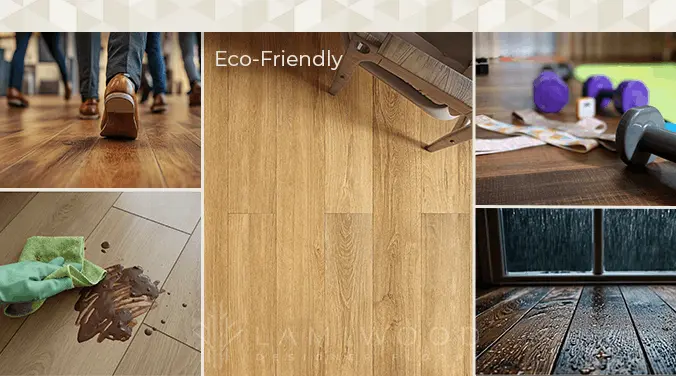
Designers can further reduce environmental impact by selecting finishes that are durable and easy to maintain. Replacing worn flooring or damaged surfaces every few years can create unnecessary material consumption.
A well-designed interior should therefore consider longevity alongside appearance. Neutral, adaptable materials can also make it easier to renovate a space without replacing every component.
Green Roofing Materials and Cool Roof Strategies
Roofs are exposed directly to sunlight, rain, temperature changes, and weather conditions, making material selection especially important. Reflective roofing surfaces can help reduce heat absorption, while appropriate insulation can limit heat transfer into occupied spaces.
Green roofs, where suitable, introduce vegetation into the roof system and can provide additional environmental benefits. They may also contribute to urban biodiversity and create visually appealing outdoor areas.
Other sustainable roofing approaches include recycled roofing products, responsibly sourced tiles, durable metal systems with recycled content, and materials designed for long service life.
The best option depends on climate, roof structure, drainage, maintenance capacity, and local weather conditions. A roof should never be selected purely for its environmental marketing claims.
Comparing Popular Green Building Materials
| Material | Common Application | Main Sustainability Advantage | Important Consideration |
|---|---|---|---|
| Bamboo | Screens, finishes, selected structures | Rapidly renewable resource | Treatment and sourcing |
| Reclaimed timber | Flooring, furniture, finishes | Reuses existing material | Quality and moisture |
| Recycled steel | Frames and reinforcement | Reduces demand for virgin resources | Verify grade and performance |
| Recycled glass | Tiles, surfaces, insulation | Diverts glass waste | Application-specific performance |
| Earth blocks | Walls | Can use local raw materials | Moisture protection |
| Low-emission paint | Interior walls | Supports healthier indoor environments | Verify product performance |
| Natural insulation | Walls and roofs | Renewable or lower-impact options | Moisture and fire performance |
| Recycled aggregate | Concrete and civil works | Reuses construction waste | Quality control |
How to Choose the Right Sustainable Material
Selecting green materials should begin with the project’s actual requirements. Climate, building type, budget, local supply, maintenance expectations, structural design, and expected lifespan all influence the final decision.
Instead of asking, “Which material is the greenest?” a more useful question is, “Which material provides the best environmental and functional performance for this application?”
A practical selection process can include:
- Define the performance requirement. Determine whether the material must provide structural strength, insulation, moisture resistance, acoustic control, or simply visual appeal.
- Compare lifecycle impacts. Consider production, transportation, installation, maintenance, and disposal.
- Check local availability. Locally available materials can reduce transportation requirements and simplify repairs.
- Evaluate durability. Longer-lasting products may prevent repeated replacement.
- Review certifications and technical data. Avoid relying solely on broad environmental claims.
- Consider maintenance. A material requiring frequent treatments or replacement may create hidden environmental costs.
- Consult qualified professionals. Structural and building-performance decisions should be verified by appropriate experts.
This approach prevents sustainability from becoming a superficial design feature.
The Role of Technology in Sustainable Material Selection
Digital tools are making it easier for construction teams to compare materials before purchasing them. Building information modeling, lifecycle assessment software, digital material databases, and environmental product information can help project teams understand the potential consequences of their choices.
Technology can also improve material efficiency by identifying quantity requirements more accurately. Better planning reduces excess ordering, cutting, transportation, and waste.
As sustainable construction becomes more data-driven, designers will increasingly evaluate materials according to measurable environmental and performance criteria rather than marketing language.
whitemagz reflects this broader transition toward smarter construction decisions, where environmental responsibility becomes part of planning, procurement, design, and long-term building management.
Challenges of Adopting Green Building Materials
Despite their advantages, sustainable materials still face challenges. Some products have limited availability, while others require specialized installation techniques or skilled workers. Initial prices can also be higher for certain products, especially when supply chains are less developed.
There can also be uncertainty about long-term performance when newer products are introduced to unfamiliar markets. Builders may prefer conventional materials because they understand their installation processes and maintenance requirements.
Education and better supply chains can gradually reduce these barriers. Manufacturers can improve product availability, architects can specify suitable alternatives, and contractors can develop expertise in sustainable installation techniques.
The key is to avoid treating green construction as an all-or-nothing decision. Even a conventional project can become more sustainable by reducing waste, improving material efficiency, selecting durable products, and making targeted substitutions.
The Future of Eco-Friendly Construction
The future of green construction will likely combine established materials with emerging technologies and improved manufacturing processes. Recycled content, bio-based materials, low-carbon cement alternatives, advanced insulation, modular construction, and material reuse can all contribute to a more resource-efficient industry.
Another important development is the movement toward circular construction. Instead of designing buildings that eventually become waste, future projects can be planned for maintenance, adaptation, disassembly, reuse, and recycling.
This changes the role of architects and builders. A successful sustainable building is not simply one that looks environmentally friendly. It is one that uses resources intelligently throughout its entire life.
whitemagz highlights why material decisions deserve greater attention in today’s construction industry. Every choice—from structural components to interior finishes—can contribute to a building’s long-term environmental performance.
Conclusion
Green building materials are helping redefine what modern construction can achieve. They offer opportunities to reduce waste, conserve resources, improve indoor environments, increase durability, and support more efficient buildings. However, sustainable construction is not about choosing the most fashionable material or replacing every conventional product. The strongest approach is thoughtful and evidence-based. Builders should evaluate where materials come from, how they are manufactured, how well they perform, how long they will last, and what happens when they are no longer needed. Recycled materials, responsibly sourced timber, bamboo, earth-based products, efficient insulation, low-emission finishes, and lower-impact concrete solutions can all play valuable roles when used appropriately.