

Artificial intelligence is moving beyond simple chatbots and automated recommendations. In 2026, the technology is becoming more capable of reasoning through complex tasks, working across different types of information, interacting with software, and supporting real-world machines. These developments are changing how people work, learn, create, shop, communicate, and make decisions.
For readers following technology trends, understanding these developments is increasingly important. The latest AI innovations are not limited to one industry. They are appearing in healthcare, education, finance, manufacturing, entertainment, cybersecurity, transportation, and everyday digital services. This article explores the most important AI developments that whitemagz readers should understand in 2026 and explains why they matter for the future.
AI Is Becoming More Agentic
One of the biggest developments in 2026 is the rise of agentic AI. Traditional AI generally responds to a prompt and produces an answer. Agentic systems are designed to take a goal, break it into smaller steps, use available tools, evaluate results, and continue working toward the desired outcome.
For example, instead of asking an AI system to summarize a collection of documents manually, a user could give it a broader objective such as analyzing the documents, identifying important trends, preparing a report, and organizing the findings. The system can potentially coordinate several stages without requiring constant instructions.
This shift makes AI more useful for professional workflows. Businesses can apply agentic systems to research, customer service, software development, scheduling, data analysis, and administrative tasks. However, human oversight remains essential when decisions have financial, legal, security, or other significant consequences.
Multimodal AI Is Becoming the New Standard
AI is increasingly capable of understanding several forms of information within the same interaction. Instead of working exclusively with text, modern multimodal systems can combine text, images, audio, video, documents, and other data.
This creates more natural ways to interact with technology. A student might provide a photograph of handwritten notes and ask for an explanation. A designer could discuss an image while requesting modifications. A business professional could upload a spreadsheet and ask an AI system to identify unusual patterns and explain them in plain language.
For whitemagz readers, multimodal AI is particularly important because it demonstrates how artificial intelligence is moving toward richer digital experiences. The distinction between text-based assistants, visual tools, voice applications, and productivity software is becoming less significant as these capabilities increasingly work together.
Why Multimodal AI Matters
Its growing value can be seen across many applications:
- Visual analysis for businesses and researchers
- Voice-based digital assistants
- AI-powered video creation and editing
- Document understanding
- Educational tutoring
- Accessibility tools
- Image and design assistance
AI Reasoning Is Getting More Sophisticated
Another important trend is the development of AI systems that spend more computational effort working through complicated problems. Rather than immediately generating a response, advanced models can approach certain tasks through deeper reasoning processes.
This is especially relevant for mathematics, programming, scientific analysis, planning, and technical problem-solving. Better reasoning can help AI handle tasks that require multiple logical steps rather than straightforward information retrieval.

The improvement does not mean AI is automatically correct. Sophisticated systems can still make mistakes, misunderstand context, or produce confident but inaccurate information. The practical advantage comes from combining stronger reasoning capabilities with reliable data, verification systems, and human judgment.
For whitemagz readers interested in future technology, reasoning-focused AI is one of the developments worth watching because it could influence everything from software engineering to scientific discovery.
AI and Robotics Are Moving Closer Together
Artificial intelligence is no longer confined to screens. Advances in computer vision, machine learning, sensors, and robotics are helping intelligent systems interact with physical environments.
Modern robots can increasingly interpret surroundings, recognize objects, follow instructions, and perform tasks with greater flexibility. This could have significant implications for warehouses, factories, agriculture, logistics, healthcare, and household applications.
Humanoid robots are also attracting attention because their physical designs are intended to operate in environments created for humans. Although widespread everyday adoption is still developing, improvements in AI models could make robots more adaptable than traditional machines programmed for narrow tasks.
The combination of AI intelligence and physical robotics could eventually create systems capable of learning from changing environments instead of simply repeating fixed instructions.
AI Is Transforming Software Development
Software development is another area experiencing rapid change. AI coding systems can help programmers generate code, explain unfamiliar functions, identify potential errors, write tests, and assist with documentation.
The most interesting development is the movement from code completion toward higher-level software assistance. Developers can increasingly describe what they want to build in natural language and use AI to help translate those requirements into working components.
This does not eliminate the need for skilled developers. Instead, it changes where their expertise is applied. Developers may spend less time writing repetitive code and more time reviewing architecture, testing functionality, managing security, and making product decisions.
For technology-focused whitemagz readers, this represents a broader lesson: AI is becoming a collaborative development tool rather than merely a code generator.
AI-Powered Personalization Is Becoming Smarter
Personalization has existed online for years, but AI is making it more adaptive. Instead of relying only on basic preferences or browsing history, intelligent systems can analyze context and interaction patterns to provide more relevant experiences.
This can appear in shopping recommendations, educational platforms, entertainment services, productivity applications, and digital assistants. AI can potentially understand what a user is trying to accomplish and adjust recommendations accordingly.
The challenge is balancing personalization with privacy. Users increasingly need transparency about how their information is collected, processed, and used. Organizations that adopt AI responsibly will need strong data governance and clear controls.
Smaller AI Models Are Creating New Possibilities
The AI industry is not only focused on making models larger. Smaller and more efficient models are becoming increasingly important because they can operate with fewer computing resources.
Compact models can be useful for smartphones, laptops, embedded devices, industrial equipment, and applications where sending data to remote servers is undesirable. Local processing can also reduce latency and improve privacy in certain situations.
This trend could make AI more accessible. Instead of requiring powerful cloud infrastructure for every intelligent feature, some applications may perform useful AI tasks directly on consumer and business devices.
The result could be a more distributed AI ecosystem where intelligence exists across cloud platforms, personal computers, smartphones, vehicles, robots, and specialized hardware.
AI Hardware Is Evolving Alongside Software
Advanced AI requires powerful computing infrastructure. As demand for AI applications grows, companies are developing specialized processors and systems designed to handle increasingly demanding workloads.
The competition is not simply about making faster chips. Efficiency, memory capacity, energy consumption, networking, and scalability are becoming equally important.
This hardware progress supports developments across the AI ecosystem. More efficient computing can make advanced models cheaper to operate and can enable intelligent features in devices that previously lacked sufficient processing power.
The relationship between hardware and software will therefore remain one of the most important technology stories throughout 2026.
AI Safety and Security Are Becoming Essential
As AI becomes more capable, concerns surrounding security and responsible deployment are receiving greater attention. Organizations must consider risks such as manipulated content, data leakage, automated attacks, biased outputs, and unauthorized AI actions.
AI is also being used defensively. Security teams can analyze large volumes of activity, identify unusual behavior, automate repetitive investigations, and respond more quickly to potential threats.
A balanced approach is becoming necessary. Innovation should not be separated from safeguards. Effective AI adoption requires testing, access controls, monitoring, privacy protection, and clear human accountability.
Key AI Innovations at a Glance
| AI Innovation | Main Development | Potential Impact |
|---|---|---|
| Agentic AI | Goal-driven task execution | Smarter automation |
| Multimodal AI | Text, image, audio and video understanding | More natural interactions |
| Reasoning AI | More advanced problem-solving | Complex analysis |
| AI Robotics | Intelligent physical machines | Industrial and household automation |
| AI Coding | Natural-language software assistance | Faster development |
| Smaller Models | Efficient local AI | Private and accessible computing |
| AI Hardware | Specialized computing systems | Faster AI workloads |
| AI Security | Automated threat detection | Stronger digital protection |
What These Innovations Mean for Everyday Users
The impact of AI innovation will not be limited to technology professionals. Ordinary users may encounter AI more frequently through smartphones, search tools, productivity applications, customer support, education platforms, vehicles, and smart devices.
People may increasingly delegate repetitive digital tasks to AI while retaining control over important decisions. Instead of simply asking a chatbot questions, users may work with AI systems that organize information, prepare drafts, analyze data, and coordinate several digital activities.
This makes AI literacy increasingly valuable. Understanding what AI can do, where it can fail, and when human verification is necessary will become an important digital skill.
For whitemagz readers, keeping up with AI does not require becoming a machine-learning engineer. Learning the major trends and understanding their practical implications can provide a strong foundation for navigating the changing digital world.
How Businesses Can Prepare for the AI Shift
Businesses that want to benefit from AI should focus on practical use cases rather than adopting technology simply because it is fashionable. The strongest opportunities often involve repetitive workflows, information-heavy tasks, customer interactions, and processes where faster analysis creates measurable value.
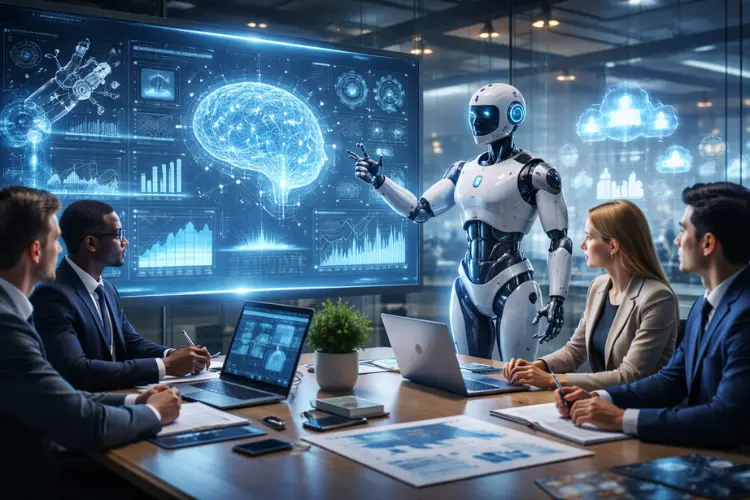
Companies should begin by identifying specific problems and then evaluating whether AI can solve them reliably and economically. Employees should also receive appropriate training so that AI becomes a productivity tool rather than an unmanaged source of risk.
Important preparation steps include:
- Identify repetitive processes suitable for automation.
- Establish rules for sensitive information.
- Test AI outputs before large-scale deployment.
- Train employees to use AI responsibly.
- Measure productivity and quality improvements.
- Maintain human oversight for important decisions.
The Future of AI Will Be More Integrated
The most important AI development may not be a single model, device, or application. It may be the gradual integration of intelligence into everyday technology.
AI is becoming part of software development, business operations, creative work, robotics, communication, education, and personal productivity. As systems become more capable, users may stop thinking about AI as a separate tool and start treating it as an underlying layer of digital infrastructure.
That transition could make technology more responsive and personalized. At the same time, it will increase the importance of privacy, transparency, security, and responsible use.
Conclusion
The latest AI innovations in 2026 show a clear movement toward systems that can reason more effectively, understand multiple forms of information, use tools, operate locally, and interact with the physical world. Agentic AI, multimodal intelligence, advanced reasoning, robotics, efficient models, AI hardware, and intelligent cybersecurity are all contributing to this transformation. For whitemagz readers, the biggest takeaway is that AI is evolving from an experimental technology into a practical part of everyday digital life. The winners in this new environment will not necessarily be those who use the most AI, but those who understand where it creates genuine value and where human judgment remains essential. As these technologies continue to mature, staying informed will help individuals and businesses make smarter choices. AI’s next chapter is not simply about machines becoming more powerful; it is about making intelligent technology more useful, accessible, and deeply connected to the way people live and work.